
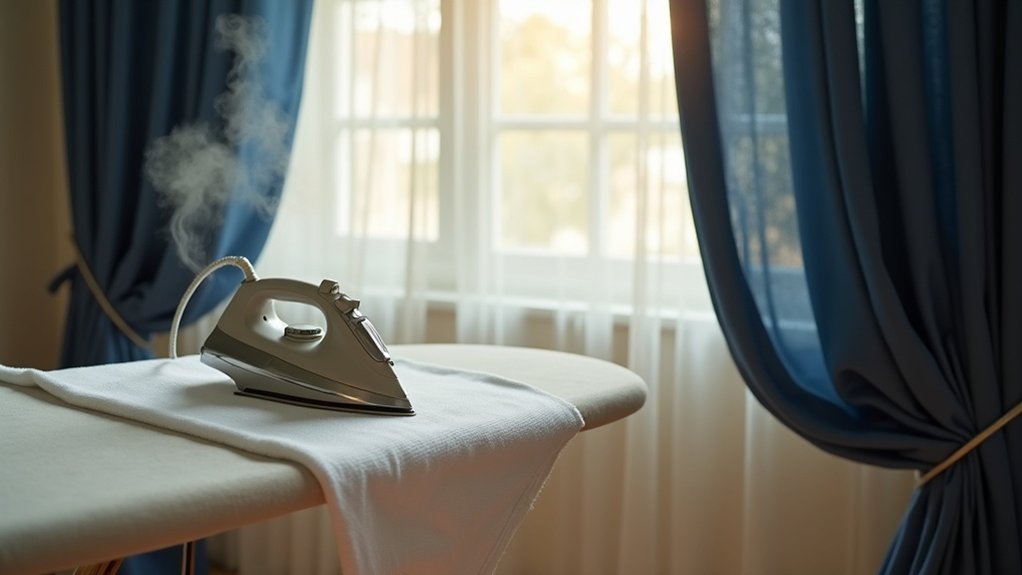
To iron your curtains, first set up a clean ironing board and gather your iron, spray bottle, and pressing cloth. Check the fabric care label for heat settings. If the fabric’s delicate, use lower heat and a pressing cloth. Lay the curtains flat and iron from top to bottom, lightly dampening stubborn creases. For hanging curtains, use a steamer from bottom to top. Want to know more techniques for specific fabrics? Keep exploring!
Key Takeaways
- Check the fabric care label for the appropriate heat settings before starting to iron your curtains.
- Use a spray bottle to lightly dampen stubborn creases while ironing for better results.
- Iron curtains from top to bottom while laying them flat on the ironing board.
- For delicate fabrics, use a pressing cloth and lower heat settings to prevent damage.
- Consider using a steamer for quick wrinkle removal, especially on delicate or pleated curtains.
Setting up Your Equipment
Before you start ironing your curtains, it’s crucial to set up your equipment correctly. Place a clean, flat ironing board close to where you’ll hang the curtains to minimize transport wrinkles.
Gather your supplies: an iron, a spray bottle filled with water, and a pressing cloth for delicate fabrics. Check the fabric care label on your curtains to determine the appropriate heat setting for the iron.
Allow the iron to heat up for about five minutes, adjusting the dial accordingly. If you’re using a steamer, set it to the gentlest setting and make sure you have space to maneuver comfortably.
Preparing Your Curtains for Ironing
Before you start ironing, check the care label on your curtains for specific fabric instructions, as this will guide you on the right heat settings.
Next, set up your ironing area close to where the curtains will hang to avoid unnecessary movement and wrinkles.
With everything in place, you’re ready to tackle those stubborn creases effectively.
Check Fabric Care Instructions
Checking the fabric care instructions on your curtains is essential, as different materials require specific ironing techniques and heat settings.
For delicate fabric like cotton and linen, handle with care to avoid damaging the fibers. If allowed, wash your curtains on a cold, delicate cycle and dry on low heat to reduce wrinkles before ironing.
Remember, blackout and polyester curtains can usually withstand higher heat. To make ironing easier, keep a spray bottle filled with water handy; dampening the fabric helps relax the fibers.
Finally, set your ironing board close to where the curtains will hang, preventing new wrinkles.
Set Up Ironing Area
Once you’ve confirmed the care instructions for your curtains, it’s time to set up your ironing area effectively. Position your ironing board close to where you’ll hang the curtain to minimize wrinkles. Heat the iron for about five minutes, adjusting the dial to match your fabric type. Fill a spray bottle with water to dampen stubborn creases. Lay the curtain flat, starting from the top and working down for thorough coverage.
| Task | Tools Needed | Purpose |
|---|---|---|
| Prepare Iron | Iron, Water Bottle | Dampen fabric, heat settings |
| Position Board | Ironing Board | Minimize transport wrinkles |
| Lay Curtain | Curtain | Guarantee even ironing of the part |
| Hang Curtain | Curtain Hooks | Finalize the process |
Choosing the Right Ironing Technique
How do you choose the right ironing technique for your curtains?
For delicate curtains like silk or satin, use a lower heat setting and a pressing cloth to avoid damage.
Velvet curtains require a steamer on low heat instead of a traditional iron; hang them to remove wrinkles effectively.
Always work from top to bottom and adjust the fabric on the ironing board to prevent bunching.
If you face stubborn creases, lightly dampen the fabric with a spray bottle.
For pleated curtains, focus on steaming and spot treating to maintain their shape.
This guarantees the best cleaning without compromising design.
Ironing Standard Curtains
Before you start ironing standard curtains, it’s essential to check the care label for specific fabric instructions. Different materials require different techniques. Set your ironing board close to where the curtains will hang. Lay the curtain flat and start ironing from the top down.
| Fabric Type | Heat Setting |
|---|---|
| Polyester | Medium |
| Blackout | Medium |
| Cotton | Low |
| Linen | Low |
Use a spray bottle to dampen the fabric as you iron, moving back and forth to eliminate stubborn creases. Once you finish two-thirds, hang the curtain to address any remaining wrinkles.
Special Care for Delicate Fabrics
When you’re dealing with delicate fabrics like silk or satin, it’s vital to take extra precautions to prevent damage.
Here are some tips to help you care for these lovely materials:
- Always use a lower heat setting on your iron.
- Place a pressing cloth between the iron and fabric for added protection.
- Test a small, inconspicuous area first to verify it can handle the heat.
- For stubborn wrinkles, lightly spray a vinegar and water solution (1:1) before ironing.
- Iron the back side of the curtains to avoid shine or scorching on the visible surface.
With these steps, you’ll keep your delicate fabrics looking beautiful!
Ironing While Hanging
Ironing curtains while they’re hanging can save you time and effort, especially if you want to avoid the hassle of taking them down.
Use a steamer for safety and ease; hold it about 6 inches away from the fabric. Work in small vertical sections, gently steaming from the bottom of the curtain up, pulling the fabric tight as you go. This technique helps eliminate creases effectively without soaking the material.
Set the steamer to the gentlest setting to protect delicate fabrics. For a quick fix, try the bathroom steam trick after a hot shower to soften those wrinkles naturally.
Using a Steamer for Curtains
Using a steamer for your curtains can save you time and prevent damage to delicate fabrics.
To effectively remove wrinkles, hang your curtains and steam from the bottom up, keeping the nozzle about 6 inches away.
Remember to use gentle strokes and focus on small sections for the best results, especially if you’re working with materials like velvet.
Benefits of Steamers
There’s no denying that steamers offer a convenient solution for tackling wrinkles in curtains.
Here are some benefits you’ll appreciate:
- Ideal for delicate fabrics like velvet, silk, and satin, preventing heat damage.
- Allows you to remove wrinkles while curtains hang, saving time.
- Effectively addresses stubborn wrinkles without creating sharp creases.
- No risk of damaging embellishments, keeping your curtains looking pristine.
- The bathroom steam trick can complement steaming, loosening wrinkles naturally.
Using steamers not only simplifies the process but also guarantees your curtains maintain their beauty, making your space inviting for all.
Steaming Techniques and Tips
When it comes to tackling wrinkles in your curtains, mastering the art of steaming can make a world of difference.
Begin by setting your steamer to the lowest heat to protect delicate fabrics. Hang your curtains securely and pull the bottom tight.
Steam from the bottom to the top, keeping the nozzle about 6 inches away while using gentle vertical strokes. Work in small sections for thorough coverage, and hold the steamer on stubborn wrinkles for a few seconds.
Alternatively, try the bathroom steam trick: run a hot shower and hang your curtains in the steamy room for natural wrinkle release.
Velvet Curtain Care
Steaming is particularly beneficial for velvet curtains, which require special care to maintain their luxurious appearance.
Follow these steps for effective steaming:
- Hang curtains on a hanger and set the steamer to the lowest heat.
- Start steaming from the bottom, pulling the fabric taut as you go.
- Maintain a distance of about 6 inches to prevent water soaking.
- Avoid using a regular iron to prevent damage.
- For a quick fix, use the bathroom steam trick after a hot shower.
Alternative Methods for Removing Wrinkles
While traditional ironing is effective, several alternative methods can help you remove wrinkles from your curtains without the hassle of setting up an ironing board.
Start by washing and drying your curtains according to care instructions, using a delicate cycle and low heat.
A handheld steamer can also work wonders while the curtains hang, but having someone assist you can yield better results.
For a quick fix, use a spray bottle filled with a wrinkle releaser, like Tom & Sheri’s Iron in a Bottle. This mimics ironing by relaxing fabric fibers, making it easier to smooth out those pesky creases.






